What a BMJ study reveals about breast biopsy interpretation, specialist expertise and the value of independent review.
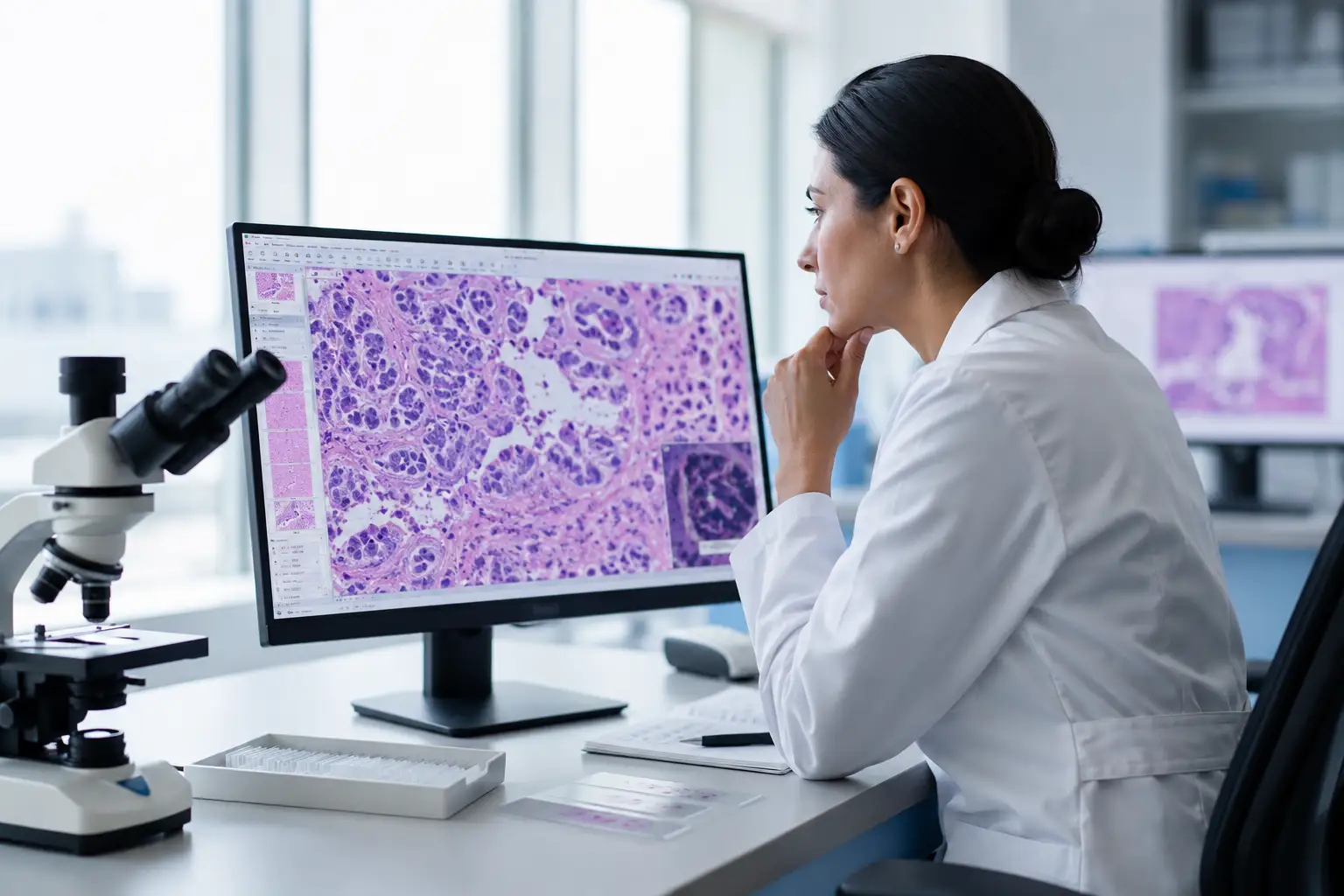
A breast biopsy can play a decisive role in a patient’s care. Its results may guide whether further tests, monitoring, surgery or treatment are recommended. Understandably, patients often assume that examining a tissue sample will lead to one definitive answer. In reality, some findings are more difficult to classify than others, even for experienced pathologists.
That is why an independent pathology opinion can be useful: not because the original doctor necessarily made a mistake, but because a second specialist may identify a different interpretation, confirm a complex diagnosis or clarify uncertainty before an important clinical decision.
What did the BMJ researchers investigate?
A 2016 study published in The BMJ, led by Joann G. Elmore and colleagues, investigated how different second-opinion strategies might improve breast histopathology interpretation. The researchers used 240 breast biopsy cases, interpreted by 115 practising pathologists, and compared their assessments with reference diagnoses established by a panel of three experienced breast pathologists.
The team simulated 12 approaches, ranging from reviewing every case to requesting extra opinions only for certain diagnoses or cases considered difficult. When the first two interpretations disagreed, a third independent interpretation was used to resolve the simulated assessment.
This was a simulation study, not a trial in which patients were assigned to different diagnostic pathways. Its figures describe disagreement with expert consensus in a deliberately challenging set of specimens, rather than the error rate of breast biopsy reporting in everyday healthcare.
What difference did a second opinion make?
Across the study’s selected cases, the overall misclassification rate after one interpretation was 24.7%. When every specimen received a simulated second opinion, with a third reviewer used where necessary, this decreased to 18.1%. That is a reduction of 6.6 percentage points, equivalent to approximately 27% relative to the original rate. The improvement was statistically significant.
| Study measure | One reading | Review of all cases* |
|---|---|---|
| Any disagreement | 24.7% | 18.1% |
| Over-interpretation | 9.9% | 6.0% |
| Under-interpretation | 14.8% | 12.1% |
*Independent second reading, with a third reading if needed. Percentages refer to the selected study cases.
The researchers also observed a reduction in over-interpretation, where a case was assigned to a more severe category than the expert reference diagnosis, from 9.9% to 6.0%. Under-interpretation also fell, from 14.8% to 12.1%. Both directions matter: one may contribute to unnecessary intervention, while the other may lead to a condition being underestimated.
However, the study did not test whether second opinions prevented surgery, changed survival rates or improved patients’ quality of life. Better agreement with an expert panel is a meaningful diagnostic measure, but it is not the same as demonstrating a clinical outcome benefit.
Why are some breast biopsy findings harder to interpret?
Not all pathology diagnoses carry the same degree of uncertainty. Findings such as atypical ductal hyperplasia (ADH) and ductal carcinoma in situ (DCIS) can be particularly challenging because diagnostic categories may share overlapping microscopic appearances.
In the BMJ study, the initial misclassification rate for specimens whose expert reference diagnosis was atypia was 52.2%, much higher than for invasive carcinoma (3.9%). Even after the broadest second-opinion strategy, misclassification among atypia cases remained 40.9%. These large percentages reflect the study’s challenging test material and should not be applied to an individual patient’s probability of having an incorrect diagnosis.
The message is not that pathology is unreliable. Rather, it shows why some borderline categories deserve particular attention, and why expert review is valuable while still being unable to eliminate every disagreement.
Does the reviewing specialist’s experience matter?
The study also considered whether case volume influenced the results. Pathologists who reported interpreting at least 10 breast biopsy specimens per week were classified as higher-volume practitioners. In a simulated strategy in which the first and second opinions came from higher-volume pathologists, the overall misclassification rate was 14.3%—the lowest of the strategies tested.
This does not mean that weekly volume alone determines professional competence. It does suggest that experience with a particular diagnostic field may be relevant when selecting a second reviewer. For difficult breast lesions, a specialist with substantial breast pathology practice may offer especially useful insight.
When might a patient consider an independent review?
There is no single rule that applies to every patient. Many pathology cases are already reviewed through laboratory quality processes and multidisciplinary teams. Still, discussing an additional independent opinion may be reasonable when:
- The report describes atypia, a borderline lesion or diagnostic uncertainty.
- The pathology result seems difficult to reconcile with imaging or clinical findings.
- A major treatment or surgical decision depends on a subtle pathological distinction.
- A patient would value clarification of a complex report before discussing next steps.
A second opinion may confirm the original assessment or identify a difference that requires discussion. Either way, it should be interpreted alongside clinical history, breast imaging and the advice of the treating team. Patients should not delay time-sensitive treatment solely to seek another review without speaking to their clinician.
Making specialist opinions more accessible
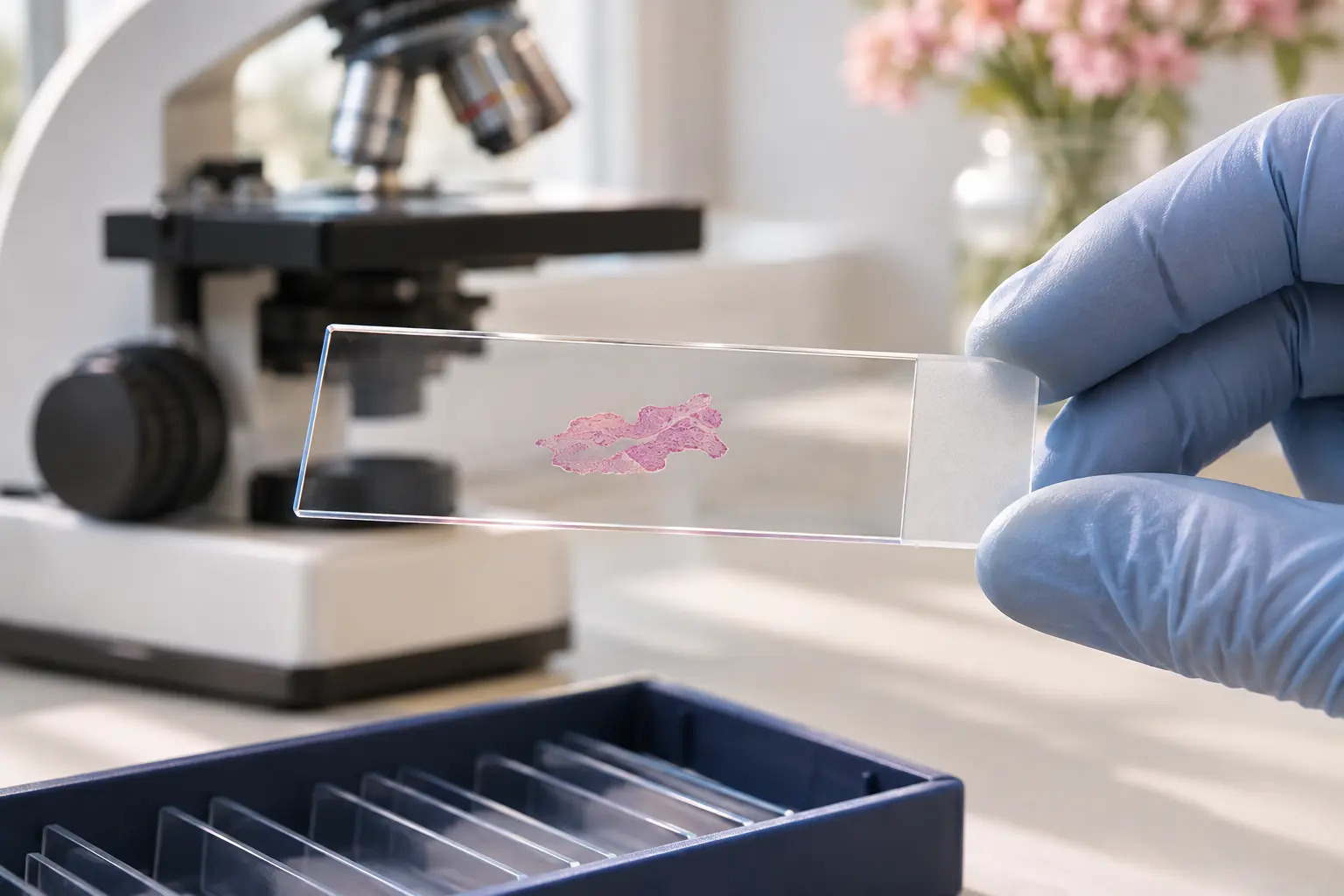
Digital pathology can make independent consultation easier by enabling suitably prepared whole-slide images to be reviewed remotely. However, a reliable assessment requires appropriate material and clinical context: a written report alone may not always be sufficient, and the original glass slides or additional tissue sections may sometimes be needed.
At Hospitual, we aim to improve access to independent specialist medical opinions, including pathology second opinions and radiology second-opinion services. For patients navigating complex findings, a specialist review may provide greater clarity and help inform conversations with their treating clinicians. Such services complement existing clinical care; they do not replace examination, multidisciplinary assessment or the treating clinician’s responsibility for management.
The key takeaway
The BMJ study supports a careful, evidence-based conclusion: structured independent reviews can improve agreement with expert breast pathology diagnoses, particularly for difficult categories, but they cannot eliminate diagnostic uncertainty. The most useful question is not simply whether a second opinion is available, but whether it brings the right expertise, adequate diagnostic material and meaningful information to the patient’s care.
For practical questions about requesting a review or submitting slides, contact Hospitual support.
Scientific source: Elmore JG, Tosteson ANA, Pepe MS, et al. Evaluation of 12 strategies for obtaining second opinions to improve interpretation of breast histopathology: simulation study. BMJ. 2016;353:i3069. doi:10.1136/bmj.i3069. Read the original BMJ study
Editorial note: The percentages cited above come from a simulation involving selected, disproportionately challenging biopsy cases. They do not represent the rate of errors in routine pathology practice and do not evaluate Hospitual’s own performance.
Medical disclaimer: This article is for general information, not individual medical advice. Decisions about diagnosis and treatment should be made with appropriately qualified healthcare professionals.