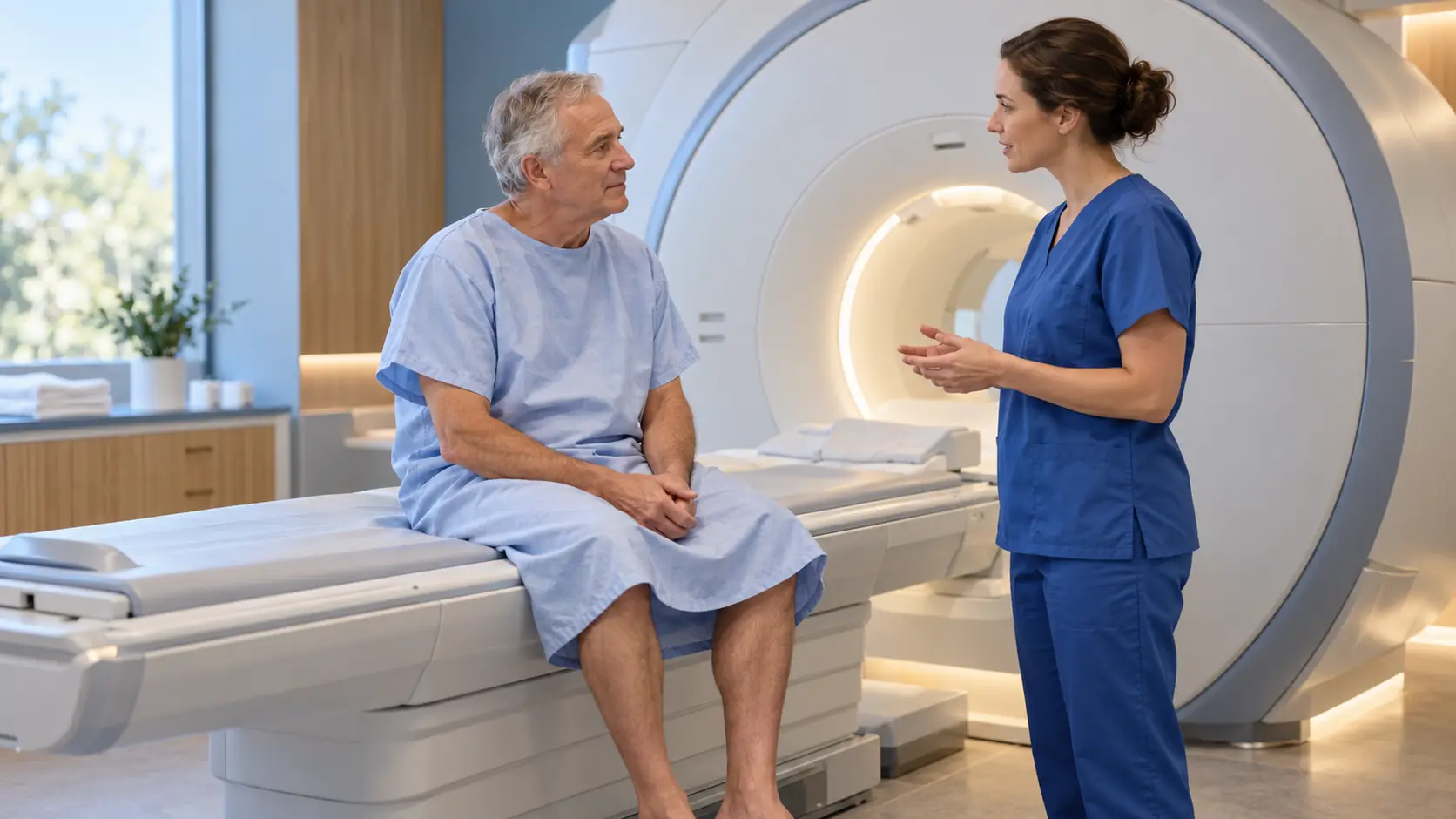
A raised PSA does not automatically mean prostate cancer, and it does not mean everyone needs an immediate MRI. The next step depends on your PSA result, medical history, examination findings and overall risk. If prostate cancer is suspected, prostate MRI can help your clinical team decide whether a biopsy is needed and where to take samples.
This guide explains how PSA and prostate MRI fit together, what the scan can show and when a specialist review of an existing MRI may help. It describes the UK diagnostic pathway; arrangements may differ in other countries.
A Raised PSA Can Be Worrying, but It Does Not Necessarily Mean Cancer
One of the most common questions after a PSA blood test is: “My PSA is raised. Does this mean I have prostate cancer?” The answer is no. PSA is prostate-specific, but it is not cancer-specific. Benign enlargement, inflammation, infection and other factors can also increase it.
Your doctor will consider your age, previous PSA results, symptoms, family history and other relevant findings. Depending on the circumstances, they may recommend a repeat blood test, assessment for infection or referral to a urology team. Do not assume that a raised result can be ignored or that it always requires the same next step. [1]
What Is PSA, and Why Can It Be Raised?
Prostate-specific antigen, or PSA, is a protein produced by prostate tissue. A small amount normally enters the bloodstream and can be measured using a blood test.
Factors that may raise PSA include:
- Benign prostatic enlargement
- Prostatitis or a urinary infection
- Recent ejaculation or vigorous cycling
- Recent urinary instrumentation or prostate procedures
- Prostate cancer
Follow the preparation instructions for your test and tell your clinician about recent infection or procedures. PSA should be interpreted in context rather than used alone to diagnose or exclude cancer. The NHS PSA test guide explains test preparation and possible next steps.
Why Is Prostate Cancer Awareness Important?
Prostate cancer may not cause symptoms at an early stage. Urinary symptoms are common, but they are often caused by benign prostate enlargement rather than cancer. Seek clinical advice if you develop concerning symptoms or want to discuss your individual risk.
Risk increases with age and is higher in Black men and people with a close family history of prostate cancer. Your clinician should consider your personal circumstances rather than relying on symptoms alone. PSA testing is relevant to men and anyone else who has a prostate. [1]
When Is Prostate MRI Recommended After a Raised PSA?
In the UK, NICE recommends multiparametric MRI as a first-line investigation for suspected clinically localised prostate cancer. This does not mean that every raised PSA result automatically requires a scan. Your clinician first considers whether further investigation is appropriate for your overall situation. [2]
Historically, many men with a raised PSA proceeded directly to systematic transrectal biopsy. Major studies, including PROMIS and PRECISION, helped establish the value of MRI before a first biopsy. MRI can identify a suspicious area for targeted sampling and help selected patients avoid an immediate biopsy. The MRI-based pathway can also reduce detection of some low-risk cancers that may never cause harm. [3] [4]
“Clinically significant” generally refers to cancer whose characteristics make it more likely to matter to health and management. Definitions vary between studies, so results from different studies are not always directly interchangeable.
What Happens During a Prostate MRI?
MRI uses a strong magnetic field and radio waves to produce detailed images without ionising radiation. Prostate imaging typically includes anatomical images and diffusion-weighted imaging, which provides information about the movement of water within tissues.
You lie on the scanner table and need to remain still while images are acquired. The machine makes loud noises, and the team provides hearing protection. Follow the centre’s preparation instructions, which may include advice about your bowel or medication.
Tell the MRI team in advance about implants, devices, possible metal fragments, severe claustrophobia or kidney problems. These details help them assess safety and plan the examination; an implant does not automatically mean that all MRI scanning is impossible.
Does Prostate MRI Always Need Contrast?
No. A multiparametric examination includes a contrast-enhanced sequence, while a biparametric examination uses anatomical and diffusion images without that contrast sequence. The protocol used depends on the centre and clinical question. Ask your MRI team which examination is planned and whether contrast is required. [5] [6]
Can a Normal Prostate MRI Rule Out Cancer?
No test is perfect. A non-suspicious MRI lowers the likelihood of clinically significant prostate cancer but does not reduce it to zero. Some cancers are too small, subtle or difficult to detect on MRI, and image quality also matters.
A reassuring scan may allow some patients to avoid or defer biopsy after discussing the risks and benefits with their clinical team. A biopsy may still be recommended when other findings remain concerning. If a biopsy is deferred, ask what PSA follow-up is needed and what would trigger reassessment. [2]
What Is PSA Density?
PSA density relates the PSA blood level to the size of the prostate: it is calculated by dividing PSA by prostate volume. This helps clinicians interpret a result in the context of an enlarged gland.
It is one part of risk assessment, alongside MRI findings, examination, PSA history, family history and previous biopsy results. There is no single number that you should use on your own to decide whether a biopsy is necessary. Your clinical team should explain how it affects the recommendation in your case. [6]
Understanding Your MRI Report: PI-RADS and Likert Scores
Radiologists commonly use PI-RADS or a Likert assessment to describe suspicion on a five-point scale. These are different assessment systems, although both communicate increasing concern with higher scores. NICE specifies Likert reporting in its diagnostic recommendations. [2] [7]
For PI-RADS, the broad meaning is:
- PI-RADS 1–2: clinically significant cancer is very unlikely or unlikely.
- PI-RADS 3: the finding is equivocal, meaning uncertainty remains.
- PI-RADS 4–5: clinically significant cancer is likely or highly likely.
A score is not a diagnosis, a cancer stage or a biopsy grade. A high score does not prove cancer, and a low score does not exclude it. Tissue sampling is used when confirmation is needed. [7]
A useful report should describe suspicious areas, their location and size, and relevant features such as possible extension beyond the prostate or abnormal lymph nodes. Ask your clinician to explain the report in the context of your clinical risk.
When Can a Prostate MRI Second Opinion Help?
Prostate MRI interpretation is specialised, and some appearances are borderline. A further radiology opinion may help when:
- The report describes an equivocal finding.
- The MRI result and the wider clinical risk do not appear to align.
- A previous biopsy was negative but concern remains.
- A major management decision depends on precise interpretation or local staging.
A second opinion is not automatically a criticism of the original report. It is an additional expert review intended to clarify uncertainty, confirm important findings or support multidisciplinary discussion. It may confirm the original interpretation and does not guarantee a different diagnosis.
The reviewer needs the complete MRI study, original report, PSA history, previous imaging, biopsy results and relevant clinical information. Our guide explains how to obtain your medical imaging files.
Hospitual offers a paid radiology second opinion service for existing imaging, subject to suitability and specialist availability. This service reviews a scan that has already been performed; it does not replace the assessment needed to decide whether you should have a new MRI or biopsy.
Five Points to Remember
- A raised PSA does not automatically mean prostate cancer.
- MRI is an important part of assessing suspected localised prostate cancer.
- A reassuring MRI may help some patients avoid immediate biopsy, but it cannot exclude all significant cancers.
- MRI findings need to be considered alongside PSA density and the wider clinical risk profile.
- A specialist second opinion may help when findings are borderline or management depends heavily on imaging.
Questions to Ask Your GP or Urology Team
- Could anything other than cancer have affected my PSA result?
- Do I need a repeat PSA test or a prostate MRI?
- What does my MRI score mean alongside my PSA density and other risk factors?
- If I do not have a biopsy now, what is my follow-up plan?
- Would a specialist review of my existing MRI help answer an unresolved question?
A raised PSA is the start of a risk assessment, not a diagnosis. Discuss how your PSA, prostate volume, MRI findings and personal risk factors fit together. Decisions about further investigation should be made with a qualified healthcare professional.
Frequently Asked Questions
Does everyone with a raised PSA need an MRI?
No. The appropriate next step depends on the result and overall clinical picture. A clinician may recommend repeat testing, further assessment or an MRI as part of investigating suspected prostate cancer.
Can I still need a biopsy after a reassuring MRI?
Yes. MRI can miss significant cancer. Your clinical team may recommend a biopsy if your overall risk remains concerning, even when the scan is not suspicious.
Does PI-RADS 3 mean I have cancer?
No. PI-RADS 3 means that the MRI appearance is equivocal. Your clinician will consider the score alongside PSA density and other findings when discussing biopsy or follow-up.
Is a second opinion the same as having another MRI?
No. A radiology second opinion reviews existing images. A new examination may be recommended if image quality or missing information prevents a meaningful assessment.
This article provides general patient education and is not individual medical advice. It does not replace assessment or follow-up with your GP or urology team.
References and Further Reading
- NHS. PSA test.
- NICE. Prostate cancer: diagnosis and management (NG131), recommendations on assessment and diagnosis.
- Ahmed HU et al. PROMIS. The Lancet. 2017;389:815–822.
- Kasivisvanathan V et al. PRECISION. New England Journal of Medicine. 2018;378:1767–1777.
- Prostate Cancer UK. MRI scan.
- European Association of Urology. Prostate cancer: diagnostic evaluation.
- Turkbey B et al. PI-RADS Version 2.1: 2019 Update. European Urology. 2019;76:340–351.