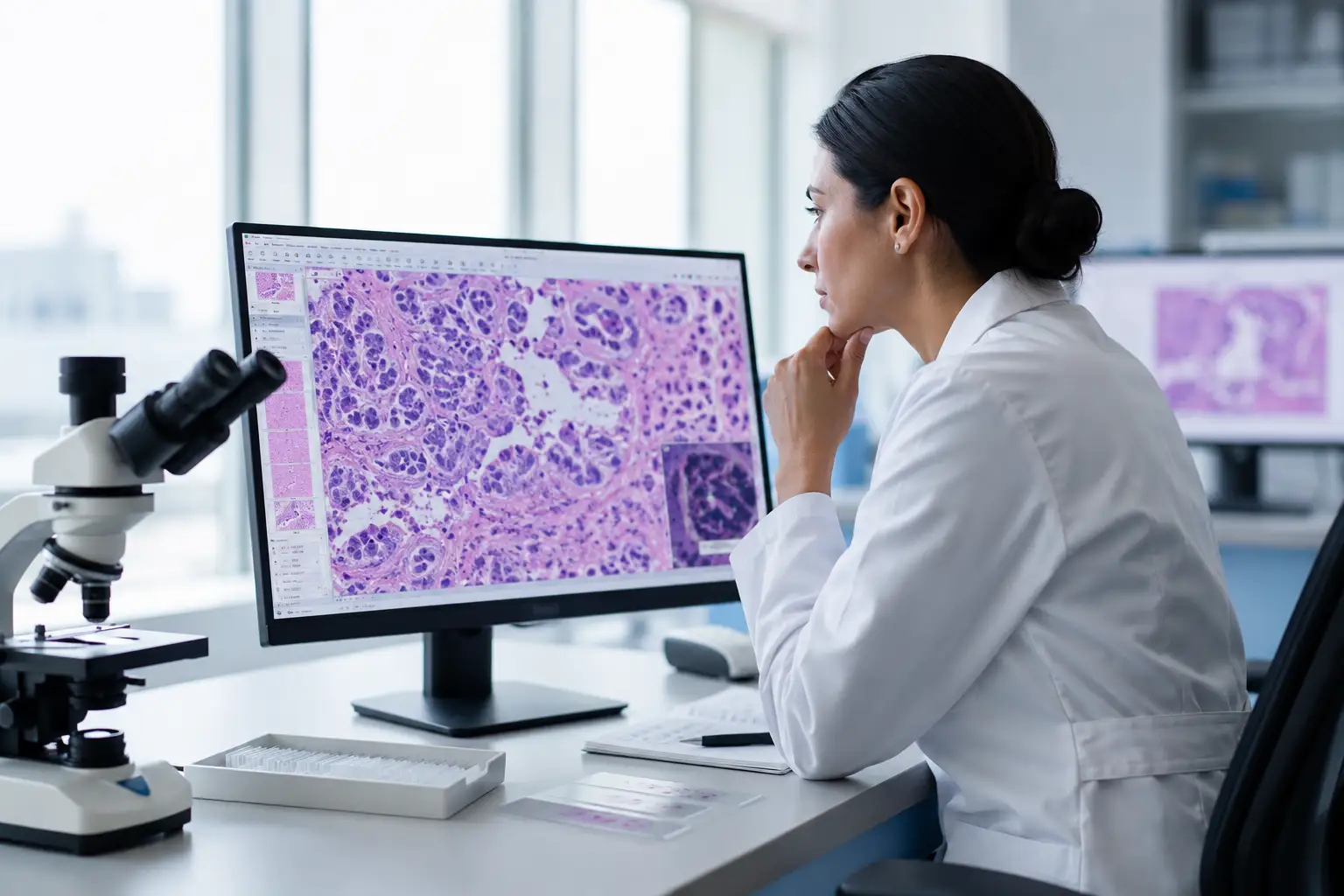
Two people can have similar breast imaging results but need different screening plans. An MRI assesses what is visible in the breast now. A genetic assessment helps clarify inherited susceptibility and its implications for future care. Neither provides the complete answer alone.
If breast cancer runs in your family, or you have received a BRCA or other genetic test result, understanding this distinction can help you ask better questions about screening and follow-up. This guide uses England’s screening programme as an example; eligibility and arrangements differ between countries.
Why inherited risk can change your screening plan
BRCA1, BRCA2 and PALB2 help maintain DNA integrity. Certain inherited pathogenic or likely pathogenic variants can increase breast cancer risk. Having such a variant does not mean cancer is present or inevitable. Its significance depends on the gene, the specific finding, age, personal history and other factors. Other syndromes, including those associated with TP53, may require different surveillance arrangements. [1] [2]
A family history may also warrant assessment even when no relevant variant has been identified. A specialist considers the pattern of cancers and ages at diagnosis, rather than simply counting affected relatives. Include information from both your mother’s and your father’s side of the family.
For a broader introduction, read our guide to genetic counselling and inherited health risks.
What MRI and genetic assessment each tell you
| Comparison | Breast MRI | Inherited-risk assessment |
|---|---|---|
| What it evaluates | Examines breast tissue for imaging findings that may need further assessment. | Considers family history and relevant genetic findings to assess susceptibility. |
| What it cannot tell you | A reassuring result does not exclude every cancer or remove future inherited risk. | A pathogenic variant does not establish that a breast lesion is cancer. |
| What may follow | May lead to additional imaging, surveillance or biopsy when indicated. | May inform screening plans, discussion of testing and advice for relatives. |
MRI uses magnetic fields and radio waves without ionising radiation. High-risk breast screening MRI typically uses intravenous gadolinium-based contrast. It is sensitive for detecting breast cancer in selected high-risk groups, but benign findings can also lead to further tests or biopsy. Mammography and MRI may be complementary; MRI is not automatically a replacement for mammography. [1] [2]
Our separate breast MRI guide explains its broader uses in diagnosis and treatment assessment.
Who may be offered enhanced MRI screening?
Eligibility depends on the applicable programme, age, genetic findings and assessed risk. A strong family history should prompt appropriate assessment, but it does not automatically establish eligibility for MRI.
In NHS England’s very-high-risk programme, eligible women with BRCA1, BRCA2 or PALB2 variants are offered annual MRI from age 25 to under 40, followed by annual MRI and mammography from 40 to under 51. From 51 to under 71, the protocol is annual mammography with MRI where indicated. These are programme-specific examples, not a personal screening prescription. [1]
Other genes have different schedules. Some eligibility routes use an age-specific ten-year risk estimate rather than a single lifetime-risk threshold. Previous treatment, more than one risk factor and individual circumstances may also affect the plan. A genetics or breast specialist should explain which pathway applies to you. [1] [3]
Three situations in which both perspectives can help
A strong family history, but no genetic test
You may not yet know whether your family history suggests an inherited predisposition. A clinical geneticist or another appropriately qualified genetics professional can assess that history and discuss whether testing or referral is appropriate. A breast team can consider the screening implications. Testing is not automatic, and you do not need to wait for a genetic result before seeking assessment of a concerning symptom.
Ask: “Does my family history warrant a formal risk assessment, and what screening should I follow while that assessment is being completed?”
A pathogenic variant and a reassuring MRI
A reassuring MRI addresses the current examination; it does not remove the inherited susceptibility associated with a pathogenic variant. Continue the surveillance plan agreed with your treating team. Conversely, an abnormal MRI is not automatically cancer because a variant is present. Imaging findings still need appropriate assessment.
Ask: “What follow-up does this scan require, and does my inherited risk affect the timing or type of my next screening examination?”
A negative or uncertain genetic result
A negative result has different meanings. If a specific pathogenic variant is known in your family and you test negative for that variant, you have not inherited that particular finding. This does not remove all breast cancer risk. If no familial cause is known, a negative test may not explain the family history, so risk assessment remains important. [2]
A variant of uncertain significance (VUS) is not a confirmed disease-causing finding. It should not, by itself, determine intensified screening or preventive surgery. Management should be based on family history and other established risk factors while the finding remains uncertain. Ask how any future reclassification would be communicated. [2]
Ask: “Is this a negative result for a known family variant, an uninformative negative result or a VUS—and what does that mean for my screening?”
Which specialist input do you need?
A clinical genetics consultation can help explain family history, existing genetic results and whether further assessment or a specialist surveillance pathway may be appropriate. A radiology second opinion reviews an existing scan and associated information to clarify imaging findings and recommendations. You may need one service, both or assessment through your usual breast team; both are not automatically necessary.
Hospitual provides access to radiology second opinions and online specialist consultations, including clinical genetics subject to availability and suitability. These are separate services, not an automatically combined multidisciplinary assessment. Recommendations should be integrated with your treating team.
A consultation does not automatically include laboratory genetic testing, arrange a new MRI or replace your local screening programme. For practical questions about services, booking or file submission, contact Hospitual support. Clinical questions are addressed within the appropriate specialist service.
What to prepare before a review
- ✓A brief family history, including cancer types, ages at diagnosis and both sides of the family.
- ✓The complete genetic laboratory report, if available, rather than only a verbal summary.
- ✓Relevant MRI, mammography and ultrasound reports, with dates.
- ✓The complete imaging study and prior comparison images if requesting an imaging review.
- ✓Relevant biopsy or treatment records, and your current screening or follow-up plan.
- ✓The specific question you want answered.
Missing information does not mean you should delay seeking appropriate care. Support can explain submission requirements. Our guide explains how to obtain your imaging files.
Questions to take to your next appointment
- 01Which risk factors are driving my screening recommendation?
- 02Does my genetic result change my plan, and why?
- 03Does MRI supplement or replace another examination in my particular pathway?
- 04What follow-up does my current imaging finding require?
- 05Should relatives seek genetic advice?
- 06Who will coordinate my plan and tell me when the next examination is due?
The aim is a clear, individual plan. Genetics helps assess inherited susceptibility; imaging evaluates the breast at the time of the scan. Understanding both can make the next conversation with your healthcare team more useful without assuming that every patient needs every test.
This article provides general education, not individual medical advice. Hospitual provides non-emergency services for adults. Seek timely assessment through your usual healthcare pathway for new breast symptoms.
References and further reading
- NHS England. Eligibility criteria and screening protocols for women at very high risk of breast cancer. Updated 18 November 2025.
- National Cancer Institute. BRCA Gene Changes: Cancer Risk and Genetic Testing.
- NICE CG164. Familial breast cancer: classification, care and managing breast cancer and related risks.